Why hotels lose direct bookings to OTAs — and the 5 website fixes.
A direct booking is a booking a guest makes with the hotel itself — on the hotel’s own website, by phone or on WhatsApp — instead of through an online travel agency (OTA) like MakeMyTrip or Goibibo. The hotel keeps the full room rate instead of paying commission on it. OTAs typically take 15–25% of every booking that comes through them. This guide explains where those bookings leak away, and the five practical fixes a hotel website needs to keep them.
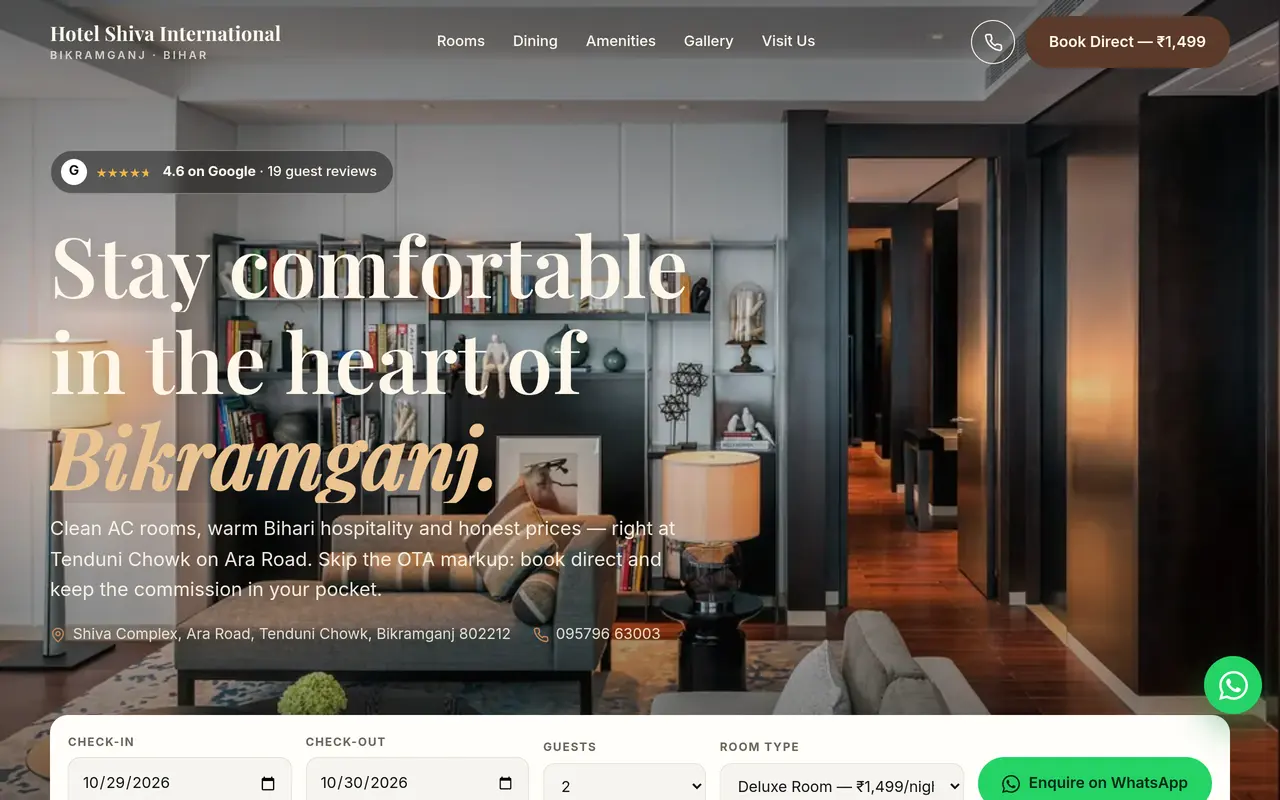
Hotel Shiva International — rooms, direct prices and a WhatsApp booking bar on the live site. The five fixes below are the same ones this site uses.
The leak
The guest found you. The booking went somewhere else.
Most independent hotels do not have a demand problem. A guest searches the hotel’s name, finds it — and then books on an app, because the hotel’s own website gave them no easier way to finish.
The pattern repeats in small hotels everywhere: the website is a brochure with a phone number buried at the bottom. No room prices. No way to send dates and get a confirmation. The guest does the sensible thing and books where booking takes thirty seconds — and the hotel pays commission on a guest it had already won.
None of this needs a booking engine, a channel manager or a large budget to fix. It needs a website built as a booking channel: prices the guest can see, a way to reach the hotel in one tap, and trust signals where the decision happens. That is what the five fixes below do, one at a time.
The 5 fixes
Five fixes. Each one closes one leak.
1. Show your real room prices
A guest cannot book direct if the price is hidden. Put every room type with its direct price on your own site, up front — the same way Hotel Shiva shows Deluxe ₹1,499, Executive ₹1,899, Family ₹2,499 and the Suite ₹2,999 per night. “Call for price” sends the guest straight back to the apps.
2. One tap to reach the hotel
A booking form that captures name, dates, room type and guests, then opens WhatsApp with the details ready to send. The hotel confirms on chat; nothing is stored on the website. No account, no phone call, no detour — the enquiry lands on the front desk’s phone.
3. Put your Google rating where guests decide
Guests check reviews before they pay. Show the hotel’s real Google rating on the site itself, next to the rooms — Hotel Shiva shows 4.6 from 19 guest reviews beside its address and check-in times. A rating the guest has to go and find is a rating that never gets seen.
4. Make it fast on a cheap phone
Most of a small hotel’s guests browse on an inexpensive phone, often on a weak connection. Compressed images, readable type and tap-friendly buttons are not polish — they are the difference between a booking and a guest who gave up and opened an app instead.
5. Keep the OTAs — give repeat guests a reason to come direct
OTAs bring guests who never heard of the hotel; dropping them would cost more than it saves. The fix is balance: show the direct price next to the app price, so a guest who already knows the hotel’s name can see the saving. Repeat guests, referrals and walk-ins then book where the hotel keeps the full rate.
What it costs to fix
Most hotel websites I build sit in the ₹15,000–₹50,000 range depending on scope — pages, photos, booking flow and automation. The detailed guide explains what moves a project within that range, without pretending there is one fixed price for every property.
The numbers on the page
One room. Three prices. One saving.
Prices as shown on the live Hotel Shiva International website. App prices are the ones listed there for this hotel; they change, so the site shows what the hotel lists at the time — not a guaranteed saving.
Deluxe Room — 1 night
Price
Who keeps what
This website (direct)
₹1,499
The hotel keeps the full rate; the enquiry reaches the front desk on WhatsApp.
Goibibo
₹1,629
Same room, booked through the app — ₹130 more for the night, plus commission to the platform.
MakeMyTrip
₹1,748
Same room, booked through the app — ₹249 more for the night, plus commission to the platform.
Room prices are the hotel’s own direct rates, shown on its live website. No booking totals or revenue figures are published here — those belong to the hotel, and this page claims none. Commission of 15–25% is the typical OTA range; the exact rate depends on the hotel’s own agreement with each platform.
Where the booking happens
OTA or direct — what actually changes.
On an OTA, the platform owns the guest’s contact details, sets the rules of the listing, and takes its cut on every night. On the hotel’s own website, the enquiry arrives on the hotel’s WhatsApp, the hotel confirms it, and the guest’s details stay with the hotel — which is also how a one-time guest becomes a repeat guest.
That is the real prize, and it is larger than one night’s commission: a guest who booked direct once can be reached again next season without paying to be re-introduced to their own customer.
What will yours cost?
Most hotel websites I build sit in the ₹15,000–₹50,000 range depending on scope. The cost guide explains what moves a project within that range — and what a hotel gets for it.
Do I still need OTA listings if I have my own website?
Yes. OTAs bring guests who never heard of your hotel — that discovery is worth paying for. The website’s job is different: it converts the guests who already found your name, your repeat guests and your referrals, so you stop paying commission on bookings you had already earned.
How much commission do OTAs actually charge?
Typically 15–25% of each booking, though the exact rate depends on the platform and your own agreement with it. Check your contract for the real number — and compare it against what one month of those commissions would buy as a one-time website.
How much does a hotel website cost in India?
Most hotel websites I build land in the ₹15,000–₹50,000 range depending on scope — pages, room types, booking flow and automation. I quote only after a short conversation about what the site has to do, never a fixed price before understanding the project. See the cost guide for what moves a project within that range.
How long does a hotel website take to build?
One to two weeks, once your content is ready — room photos, prices, policies and details. The build itself is the fast part; gathering honest prices and photos is usually what takes the time.
Can my hotel get the same structure as the Shiva site?
Yes. The layout, room pages, price table and WhatsApp enquiry flow are reused; your rooms, prices, photos, policies and brand replace the Shiva content. See the hotel websites service page for what a project includes, or the Hotel Shiva case study for the full walkthrough.